
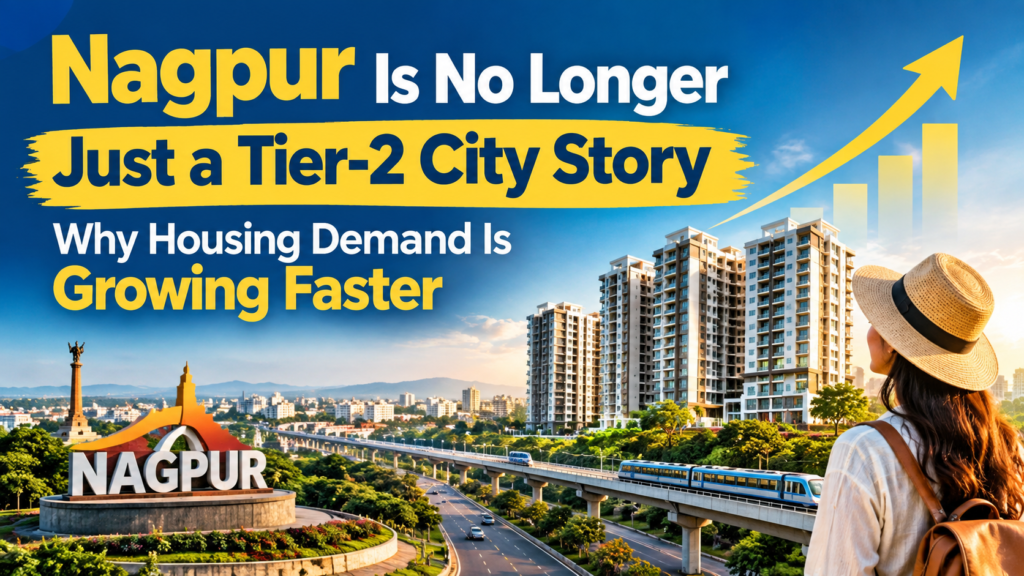
Nagpur Is No Longer Just a Tier-2 City Story: Why Housing Demand Is Growing Faster
For years, Nagpur was often put into the same bucket as other Tier-2 cities in India.
Affordable city.
Good roads.
Central location.
Lower property prices compared with Mumbai and Pune.
That was more or less the story.
But something has changed.
Nagpur’s housing market is growing faster than the broader Tier-2 housing market. Crisil Intelligence reported in 2026 that residential demand across 10 major Tier-2 cities grew at around 14% CAGR between FY21 and FY26. Nagpur, along with Coimbatore and Lucknow, recorded a much stronger growth rate of around 20% CAGR during the same period.
That difference matters.
A 14% growth story is good. A 20% growth story tells you that something more is happening in the local market.
So, what is driving Nagpur real estate growth?
Is it only because property is cheaper?
Not really.
The story now includes infrastructure, jobs, connectivity, new residential corridors, changing buyer preferences and the city’s growing role as a logistics and business centre.
Let’s look at what is actually happening with the Nagpur property market in 2026.
Nagpur Real Estate Growth: What the 20% CAGR Really Tells Us
Let’s start with the number that has attracted attention.
According to Crisil Intelligence, housing demand in India’s major Tier-2 cities grew at a 14% CAGR between FY21 and FY26.
Nagpur was among the cities where demand grew at around 20% CAGR.
That’s not a small difference.
Think about it this way.
If one market keeps growing at 14% while another grows at 20%, the second market can create a much bigger increase in demand over several years.
This is one reason why the phrase “Nagpur is just another Tier-2 city” feels a little outdated now.
The city still has Tier-2 characteristics, especially when you compare property prices with Mumbai, Pune or Bengaluru.
But the reasons people are buying property are changing.
People aren’t only buying because Nagpur is affordable.
They are also looking at:
Better road connectivity
Nagpur Metro expansion
MIHAN and nearby employment activity
Samruddhi Mahamarg
Industrial and logistics development
Educational institutions
Healthcare infrastructure
Growing residential corridors
Larger homes at comparatively accessible prices
This combination is what makes Nagpur interesting.
Nagpur Housing Demand Is Not Coming From One Type of Buyer
One thing I find interesting about Nagpur housing demand is that it isn’t limited to a single buyer group.
You have first-time homebuyers.
You have families looking for bigger homes.
You have people moving closer to work.
You have investors looking for plots and apartments.
And then there are buyers from outside Nagpur who are looking at the city because of its infrastructure story.
Crisil also pointed towards a growing preference for larger and premium homes across many Tier-2 markets, along with healthy inventory levels and stronger home-loan activity.
This is important because housing demand is not just about the number of people looking for homes.
The type of home people want matters too.
A buyer who previously searched for a small 1 BHK may now be looking for a 2 or 3 BHK.
A family that once considered an apartment may now compare it with a residential plot.
And someone buying a home for personal use may also think about its resale value five or ten years down the line.
That changes the property market.
Why Is Nagpur Growing Faster Than the Broader Tier-2 Market?
There isn’t one simple answer.
Nagpur has several growth factors working at the same time.
1. Infrastructure Has Changed the Property Map
Infrastructure is one of the biggest reasons behind Nagpur real estate growth.
The city has seen development around roads, metro connectivity, expressways and major employment zones.
The Samruddhi Mahamarg has strengthened Nagpur’s road connection with Mumbai and other parts of Maharashtra.
Nagpur Metro has also changed how people think about distance within the city.
When connectivity improves, areas that once felt far away can suddenly become practical residential options.
This is already visible in parts of South Nagpur and along important growth corridors.
The Nagpur Municipal Corporation has also highlighted the role of MIHAN, Samruddhi Mahamarg, major educational institutions and improved transport infrastructure in the city’s development.
And this is where real estate gets interesting.
A road or metro line does not automatically make every nearby property a good investment.
But better connectivity can make certain locations more useful for people who actually live and work there.
That creates genuine housing demand.
2. MIHAN Is More Than Just a Real Estate Keyword
You will hear the word MIHAN quite often when discussing Nagpur property.
But it is worth understanding why.
MIHAN combines airport-linked infrastructure, business activity, logistics and employment potential.
The Nagpur Municipal Corporation has noted that MIHAN has attracted companies and helped create employment opportunities, while also adding to the city’s economic base.
For residential real estate, employment matters.
People working in a particular corridor eventually need homes nearby.
Some rent.
Some buy apartments.
Some prefer plots and independent homes.
That creates a natural connection between employment growth and housing demand.
This is one reason areas around Wardha Road, MIHAN, Khapri, Jamtha and nearby South Nagpur locations keep appearing in conversations about the city’s future growth.
3. Nagpur Property Prices Still Give Buyers Some Breathing Room
Let’s talk about the obvious factor.
Price.
Mumbai is expensive.
Pune is expensive.
Bengaluru is expensive.
Nagpur is still comparatively affordable for many buyers.
That doesn’t mean every property in Nagpur is cheap.
It isn’t.
Nagpur property prices vary a lot depending on the location, road access, project quality, land title, amenities and development around the area.
A property close to established infrastructure can be priced very differently from one sitting on the outskirts.
That’s why simply asking, “What is the price per square foot in Nagpur?” doesn’t give you a useful answer.
You need to ask a better question.
“What am I getting for that price?”
For example:
Is the property close to an existing road?
Is public transport available?
Are schools and hospitals nearby?
Is the area already populated?
Is there employment nearby?
Is the project legally clear?
Is the area likely to attract end-users?
Can you resell the property easily?
These questions matter more than chasing the cheapest rate.
Nagpur Property Market 2026: Where Are Buyers Looking?
There is no single “best” area for everyone.
Your purpose matters.
Someone buying a home for their family will have different priorities from someone buying a plot for long-term investment.
Still, several locations and corridors deserve attention.
Wardha Road
Wardha Road has become one of the major residential and investment corridors in South Nagpur.
Its location connects several important areas, including the airport and MIHAN region.
The corridor also benefits from access to major roads and the wider Samruddhi Mahamarg network.
Current market guides show Wardha Road as one of the areas attracting residential interest because of connectivity and surrounding development.
For a buyer, the important point is not simply that prices may rise.
It is that people actually want to live around well-connected areas.
That can support long-term demand.
MIHAN and Khapri
If your thinking is connected to employment, logistics and airport access, MIHAN and Khapri deserve a closer look.
The area has a different character from established central Nagpur.
It is more about future growth and large-scale development.
That can be attractive for some investors.
But you should also check how developed the exact pocket is before buying.
A location can look promising on a map and still take years to develop properly.
Besa and Beltarodi
Besa and Beltarodi have become familiar names among Nagpur homebuyers.
These areas offer a mix of apartments, plotted developments and independent housing.
They are also connected to the broader South Nagpur growth story.
For families, existing social infrastructure can be just as important as future infrastructure.
You don’t want to buy a home today and wait five years for basic daily facilities.
Manish Nagar
Manish Nagar has benefited from its connection to Wardha Road and South Nagpur.
It is more established than some of the newer peripheral corridors.
That makes it worth considering for buyers who want a balance between connectivity and residential development.
Hingna
Hingna has a different demand story.
Industrial activity, educational institutions and employment opportunities support housing demand in and around the area.
It can be relevant for buyers looking at both residential use and rental potential.
What About Nagpur Real Estate Investment?
This is where buyers need to slow down.
Real estate investment is not simply:
Buy property → wait → price goes up.
It doesn’t work that neatly.
For property investment in Nagpur, you need to look at the reason behind future demand.
Ask yourself:
Why would someone want this property five years from now?
If the answer is only “because someone told me rates will double”, that’s not enough.
Look for practical reasons.
For example:
New employment nearby
Better road connectivity
Metro access
Population growth
Schools and hospitals
Commercial development
Existing residential communities
Rental demand
Limited availability of suitable land
These factors can support demand.
They don’t guarantee appreciation, but they give you something concrete to analyse.
Plot vs Flat: What Makes More Sense in Nagpur?
This is probably one of the most common questions buyers ask.
And honestly, there is no universal answer.
A plot may make sense if:
You have a longer investment horizon
You want flexibility to construct later
You understand the location well
The land title and approvals are clear
You are comfortable waiting for the area to develop
A flat may make sense if:
You want to live in the property soon
You need amenities and security
You want easier maintenance
You are looking at rental income
The project is in an established residential area
The mistake is buying based only on the assumption that one property type always gives better returns.
Location usually matters more than the label “plot” or “flat.”
Best Areas to Buy Property in Nagpur
If you’re searching online for the best areas to buy property in Nagpur, don’t look for one universal winner.
Instead, divide your search according to your goal.
For family living:
Manish Nagar
Besa
Beltarodi
Established parts of Wardha Road
For future development:
MIHAN
Khapri
Jamtha
Selected areas around South Nagpur
For industrial and employment-linked demand:
Hingna
Butibori
Areas connected to major industrial corridors
For premium established living:
Dharampeth
Sadar
Established central Nagpur areas
The right choice depends on your budget, timeline and purpose.
Nagpur Tier 2 City Growth Is Also About Changing Buyer Expectations
There is another side of the story that numbers don’t always show.
Nagpur buyers are becoming more selective.
People want better layouts.
They want parking.
They want security.
They want open spaces.
They want nearby schools and hospitals.
They want better roads.
And many buyers now compare several projects before making a decision.
This is partly why larger and better-quality homes are gaining attention in Tier-2 markets.
Crisil’s 2026 report also points to increasing preference for larger and premium housing in these cities.
So the market isn’t simply growing in volume.
Buyer expectations are changing too.
What Could Drive Nagpur Real Estate Future?
Looking ahead, Nagpur’s property market will probably remain closely linked to infrastructure and employment.
A few factors deserve attention.
Nagpur Metro expansion
Metro connectivity can influence residential preferences because commuting becomes easier.
But buyers should distinguish between an operational metro connection and a project that is only proposed.
Don’t pay today’s premium only for tomorrow’s promise.
Samruddhi Mahamarg
The expressway has strengthened Nagpur’s connection with Mumbai and other parts of Maharashtra.
That has implications beyond travel.
Better connectivity can support logistics, business activity and land development around connected corridors.
MIHAN and employment
Employment is perhaps the most important long-term factor.
People need homes near jobs.
If business and industrial activity continues to expand, nearby residential demand can follow.
Education and healthcare
Nagpur already has major educational and healthcare institutions.
AIIMS, IIM Nagpur, VNIT and other institutions add to the city’s wider ecosystem. The municipal report also highlights the contribution of major educational institutions to Nagpur’s development.
These institutions don’t just attract students.
They also bring professionals, support services, rentals and families.
That creates another layer of housing demand.
Should You Buy Property in Nagpur in 2026?
If you’re considering property investment in Nagpur, don’t make the decision just because you saw a 20% CAGR figure.
That number is useful.
But it doesn’t tell you whether one particular plot, flat or project is worth buying.
Before putting down your money, check:
Exact location
Current market rate
Nearby property rates
Road access
Metro status
Development already completed
Upcoming infrastructure
Rental demand
Builder reputation
MahaRERA details where applicable
Title and approval documents
Property taxes and other dues
Resale demand
Total purchase cost, not just the quoted property price
This last point is easy to forget.
A property advertised at a certain price can cost much more after registration, stamp duty, brokerage, maintenance, parking and other charges.
Calculate the full amount.
Nagpur Real Estate Future: Growth, But Not Every Property Will Win
This is probably the most important part.
Nagpur’s housing market is growing.
The Crisil data gives us a strong reason to pay attention. Around 20% CAGR in housing demand between FY21 and FY26 puts Nagpur well ahead of the 14% CAGR recorded across the broader Tier-2 group.
But that doesn’t mean every property in Nagpur will rise at the same speed.
Real estate is local.
Sometimes even two projects five kilometres apart can have very different demand.
One may have good roads, schools and daily conveniences.
The other may still be waiting for basic development.
One may have clean documentation.
The other may have legal complications.
One may attract actual homebuyers.
The other may depend mostly on investors.
That’s why the smarter question isn’t:
“Will Nagpur property prices increase?”
A better question is:
“Which locations have real demand, and why?”
The Bigger Picture for Nagpur Property Buyers
Nagpur still has the affordability advantage that many Tier-2 cities are known for.
But the city is developing beyond that simple identity.
The 20% housing-demand CAGR reported by Crisil between FY21 and FY26 shows that Nagpur has been one of the stronger performers among the major Tier-2 markets.
Infrastructure is helping.
Employment is helping.
Connectivity is helping.
And changing homebuyer preferences are helping too.
That combination explains why Nagpur is getting more attention from both homebuyers and property investors.
So, is Nagpur still a Tier-2 city?
Technically, yes.
But when you look at the direction of its housing market, that label doesn’t tell the whole story anymore.
For someone considering property in 2026, Nagpur deserves a closer look.
Just don’t rush into a purchase because everyone around you is talking about future growth.
Visit the location.
Compare prices.
Check the documents.
Look at the surrounding development.
And most importantly, ask who will want to live there five years from now.
That answer may tell you much more about the future of Nagpur real estate than any property brochure ever will.
Share via: